












5 Garden Hoses You Can Count On: Our Top Picks

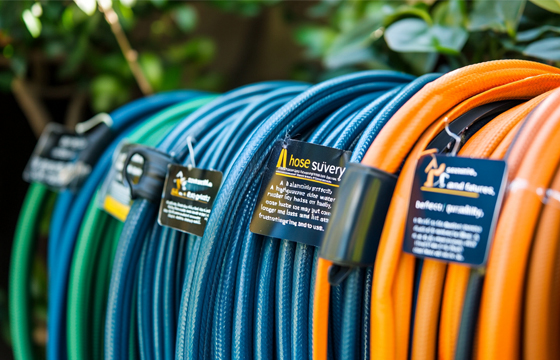
Selecting the perfect garden hose depends on your specific needs, whether for lawn care, container gardening, or cleaning tasks. To identify the best options, our team of Prodgide senior gardening editors tested 30 garden hoses in our Lab, assessing design, ease of use, durability, and value. We also incorporated expert insights to guide our evaluations.
As our editors note, “No hose suits every scenario perfectly. It’s about balancing convenience, durability, price, and features. A high-quality rubber water hose or heavy duty water hose may cost more, but it lasts longer and is less frustrating to use.”
Explore our top picks and expert tips to choose the ideal garden hose, whether you’re curious about garden hose GPM, how much water does a soaker hose use, or seeking a durable rubber water hose for your needs.
Best Overall:
Flexzilla Garden Hose at Amazon $40
Best Heavy-Duty:
Eley Polyurethane Garden Hose at Amazon
Best Rubber:
Briggs and Stratton Heavy-Duty Garden Hose at Amazon $46
Best Soaker:
H2O Works Garden Flat Soaker Hose at Amazon $20
Best Coil:
1. Best Overall: Flexzilla Garden Hose
- For everyday watering jobs, the Flexzilla Garden Hose is a great all-around choice. It is easy to move around things like patio chairs because it is made of a flexible hybrid polymer. The design that keeps it from kinking really works, and it straightens out easily when taken off the reel. While it's one of the lighter hoses on our list, it gets heavy when it's full of water.
- The anodized aluminum couplings have a coating that makes them easy to hold on to and pull across the yard. Additionally, its bright lime green color makes it simple to find in your yard. You can also safely fill your pet's bowl with water or even take a sip from the hose because the mixed polymer material is safe to drink. Even though it's not the strongest on the market, it's strong enough for daily watering.
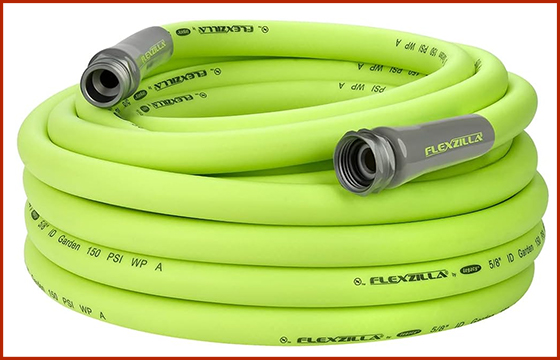
PHOTO: amazon
Material: Hybrid polymer | Length: 50, 75, or 100 feet | Diameter: 5/8 inch | Weight: 8 pounds | Couplings: Anodized aluminum | Maximum Pressure: 150 PSI
What We Like: The hose is very flexible and won't kink, so it's easy to get around things.
What Could Be Better: It's a bit heavy, especially when it's full of water.
2. Best Heavy-Duty: Eley Polyurethane Garden Hose
- Polyurethane is a newer material for outdoor hoses, but it's quickly becoming popular because it's light, flexible, and lasts a long time. The company that makes the Eley Polyurethane Garden Hose says it is the "most durable garden hose available" because it doesn't tear, puncture, kink, or break easily. You won't have to worry about damage when you drag it across rough surfaces like rocks or asphalt. It's made of the same tough material that's used to make in-line skate wheels, which is pretty cool.
- The hose didn't kink during our tests, and it was a lot lighter than regular rubber hoses. It is made of lead-free metal and can handle drinks. The hose we tried, on the other hand, was too short to be useful, but it comes in lengths from 6.5 feet to 200 feet. Remember that this hose is a lot more expensive than our Best Overall pick, so it's best for people who need to water their plants often or with a lot of force. The guarantee for 10 years gives you even more peace of mind.
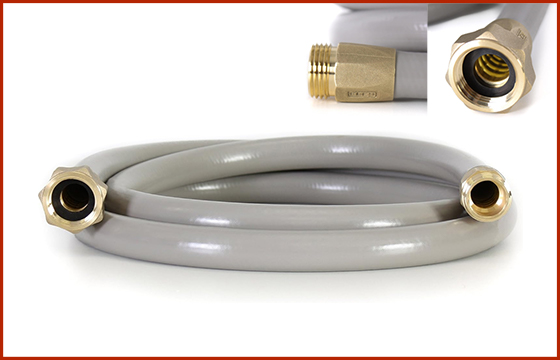
PHOTO: amazon
Material: Polyurethane | Length: 6.5, 12, 25, 50, 75, 100, 125, 150, 175, or 200 feet | Diameter: 5/8 inch | Weight: 1 to 28 pounds | Couplings: Brass | Maximum Pressure: 150 PSI
What We Like:You can't poke holes in it, kink it, crush it, or wear it down, so it's strong enough to drag over rough surfaces like rocks or asphalt.
What Could Be Better:It costs more than a lot of other yard hoses.
3. Best Rubber: Briggs and Stratton Heavy-Duty Garden Hose
- When it comes to heavy-duty use, rubber hoses last longer and cost less than polyurethane choices. We found this hose to be easy to move, even when it was full of water, even though it has a reputation for being heavy.
- It was strong enough to handle being dragged across rocks, grass, and even a rake. It's available in four lengths, from 25 feet to 100 feet, so it can be used in a lot of different places. The metal couplings with nickel plating are strong and easy to connect to nozzles and spigots.
- The maker says it can handle temperatures up to 200°F, but we found that the black rubber gets very hot in full sunlight, so don't leave it out when it's hot. In your yard, the black color might be harder to find, but its neutral tone makes it easy to integrate.
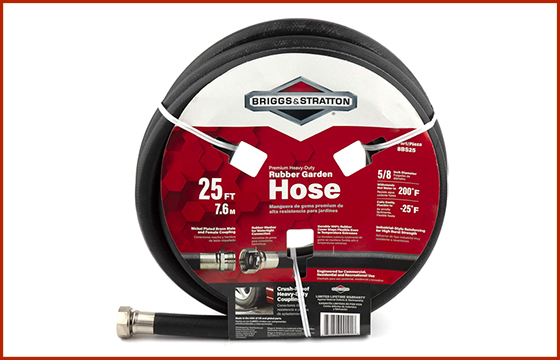
PHOTO: amazon
Material: Rubber | Length: 25, 50, 75, or 100 feet | Diameter: 5/8 inch | Weight: 4.82 pounds | Couplings: Nickel-plated brass | Maximum Pressure: Not listed
What We Like: It’s highly durable yet more manageable than most rubber hoses.
What Could Be Better: The hose heats up significantly when left in direct sunlight.
4. Best Soaker: H2O Works Garden Flat Soaker Hose
- You don't have to carry around a full-size hose when you use a coil hose to water small areas like flower beds, veggie gardens, patios, or urban container gardens. Not only is this one light and easy to carry, but it also returns to its original shape for easy storage—you don't have to wind it back up on a reel by hand.
- We found the hose lightweight and easy to maneuver around flower beds and pots, and it withstood being dragged across rocks and over a rake. Made from PVC with UV inhibitors, it’s designed to last even under direct sunlight.
- After three months of outdoor use, it still performed well. However, we did encounter some issues with kinking when trying to roll it back onto the reel. It's also important to avoid exceeding 60 PSI, as higher pressure could cause the hose to burst. Overall, this is an excellent choice for watering the roots of your plants without the hassle of moving a traditional hose.
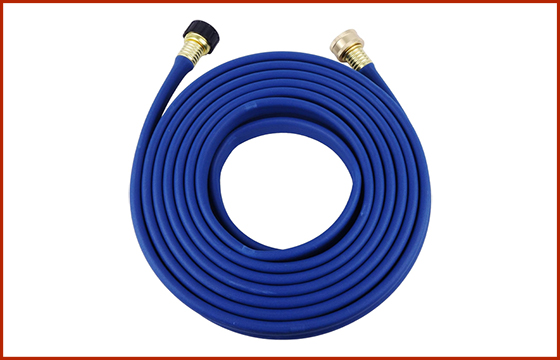
PHOTO: amazon
Material: PVC | Length: 25 or 50 feet | Diameter: 1/2 inch | Weight: 1.8 or 3.9 pounds | Couplings: Brass | Maximum Pressure: 60 PSI
What We Like: This hose is lightweight, easy to move around, and delivers up to two gallons of water every two minutes.
What Could Be Better: Kinking makes it tricky to reload onto the reel.
5. Best Coil: Water Right Garden Hose
- You don't have to carry around a full-size hose when you use a coil hose to water small areas like flower beds, veggie gardens, patios, or urban container gardens. Not only is this one light and easy to carry, but it also returns to its original shape for easy storage—you don't have to wind it back up on a reel by hand.
- This hose is unique because it is made of long-lasting, UV-stabilized polyurethane that is bendable, won't puncture, and is light. The metal couplings that don't contain lead are strong and have been used for three months. It's also one of a kind because the tail ends are straight, which makes it easier to direct the water flow and connect it to the faucet. Also, you can drink from it without worrying. But the 3/8-inch width might make it hard for water to flow, so it works best for low-pressure watering.
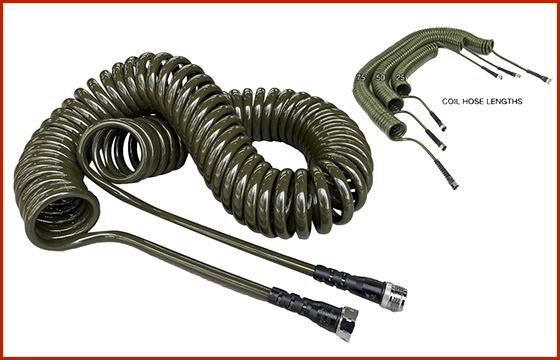
PHOTO: amazon
Material: Polyurethane | Length: 25, 50, or 75 feet | Diameter: 3/8 inch | Weight: 2, 3.4, or 4.6 pounds | Couplings: Brass | Maximum Pressure: 50 PSI
What We Like: It's easy to use, light, and movable.
What Could Be Better: It's not made to be watered with high pressure.
How to Buy the Best Types of Garden Hose
Choosing the right hose involves balancing factors like durability, flexibility, and price. There are several types to consider:
- Standard Hoses: Great for all-purpose tasks like watering and cleaning, but can kink and need to be coiled. Heavy-duty options are better for hot water and constant use.
- Expandable Hoses: Compact and lightweight, these hoses expand when filled with water and shrink when not in use. However, they’re more prone to rips and snags.
- Soaker Hoses: Best for delivering water directly to roots with minimal waste. These hoses can be buried or pinned down but require attention to stay in place.
- Coil Hoses: Ideal for small areas, these hoses retract into a coil for easy storage but are typically shorter and may get tangled.
Materials
- Polyurethane: Lightweight, durable, and resistant to kinking, though pricier than rubber.
- Rubber: Durable and affordable but heavier, especially when filled with water.
- Vinyl: Lightweight and inexpensive but not as durable and more prone to kinking.
- Stainless Steel: Known for its rust-resistance and enhanced durability, often used in high-quality hoses.
Size Considerations
- Diameter: 5/8-inch is standard, balancing water flow and ease of use. Larger diameters offer better pressure but add weight.
- Length: Choose a hose long enough to reach your watering areas without excess. Water pressure reduces with longer hoses.
- Weight: Heavier hoses are usually more durable but harder to handle, so pick one you’re comfortable using.
Burst Strength
Measured in PSI, burst strength indicates how much pressure a hose can handle before breaking. Higher PSI means more durability.
Couplings
The fittings at the end of the hose are crucial. Brass or plated brass fittings last longer than aluminum or plastic, which are lighter but less durable.
How to Prevent Kinking and Knotting?
To avoid kinks and knots that restrict water flow, store hoses flat when possible. If coiling is necessary, start with the hose stretched out and coil carefully. Thicker hoses, like rubber or heavy-duty options, are less likely to kink.
How to Store a Garden Hose?
The best way to store a hose is by laying it flat in sections, but when that's not feasible, coil it after stretching it straight. Don’t force the coil; alternate the coils if needed. Avoid leaving the hose in direct sunlight or outdoors during winter to protect the material.
Is a Hose Nozzle Necessary?
A hose nozzle helps control water flow and distribution, preventing waste. It offers different spray patterns and can shut off the flow, which is handy for cleaning or directing water precisely. Fireman-style nozzles provide a strong spray for heavy-duty tasks.
 Top Headlines